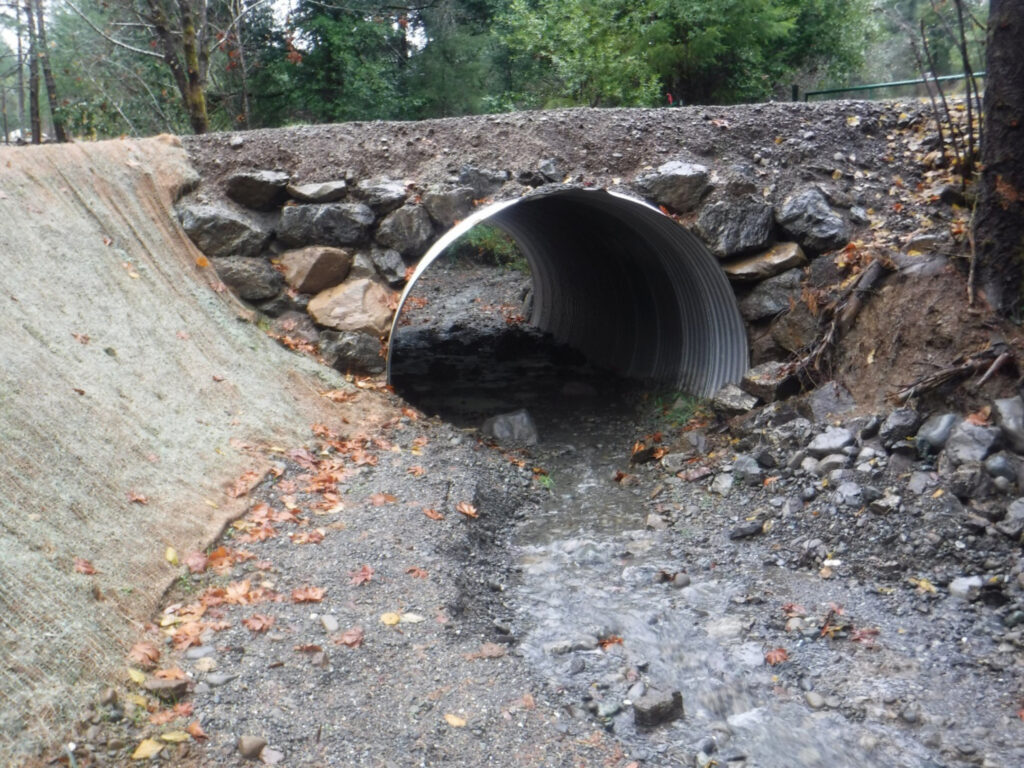
This project removed three undersized culverts on Dinner Creek at Briceland Thorne Road in Humboldt County — including a complete barrier to all life stages — and supplemented emergency replacement work with habitat improvements including river-run gravels, roughened channel work, and instream fish structures. Located in the South Fork Eel River watershed, the project opened 1.8 miles of spawning and rearing habitat and included riparian revegetation, benefiting coho salmon and steelhead.
Location: Dinner Creek at two locations on Briceland Thorne Road, approximately 8.5 miles west of Redway in Humboldt County, California. Dinner Creek is a tributary to China Creek, which flows into Redwood Creek, a tributary to the South Fork Eel River. The South Fork Eel River is a major tributary to the Eel River, which flows to the Pacific Ocean in Humboldt County.
Historical Presence of Anadromous Fish: Dinner Creek supports both coho salmon and steelhead. In 2012, CDFW staff observed juvenile coho salmon immediately downstream of the Site 1 culvert, and juvenile steelhead were observed upstream and downstream of both barrier sites across multiple age classes. The project is consistent with the 2004 CDFW Recovery Strategy for California Coho Salmon, which identifies maintaining and improving key coho populations in streams such as those in the South Fork Eel watershed as a primary recovery goal.
Project Lead Organization: Humboldt County Department of Public Works
Project Partners: California Department of Fish and Wildlife (CDFW); U.S. Fish and Wildlife Service (USFWS); NOAA/National Marine Fisheries Service (permitting and design consultation); Ross Taylor and Associates (fish relocation and monitoring); Wilcox Enterprises (construction contractor); Ontiveros (pre- and post-construction surveys); Humboldt Fish Action Council (revegetation).
Project Description: The project removed three fish passage barriers on Dinner Creek: two undersized culverts at Briceland Thorne Road (Post Miles 3.74 and 3.27) and an additional undersized culvert on a private driveway. Site 1 (PM 3.74) was a partial barrier to adult steelhead and included a concrete weir; Site 2 (PM 3.27) was a complete barrier to all life stages. Site 2’s culvert failed during the 2017 winter storms and was replaced with emergency federal highway funds; this grant funded supplemental habitat improvements at that site including river-run gravels, roughened channel work, and instream fish structures. Site 1 construction ran from July through October 2018. The project also included revegetation with 102 native plantings completed in February 2019.
Expected Completion: Fall/Winter 2019.
Project Effectiveness: Shortly after the emergency 2017 culvert replacement at Site 2, CDFW staff observed three adult steelhead holding in a pool above the newly replaced culvert in February 2018 — an early indicator of improved passage. The project opened a total of 1.8 miles of spawning and rearing habitat. This project was selected for CDFW/PSMFC effectiveness and validation monitoring, which includes pre- and post-treatment snorkel and spawner surveys.