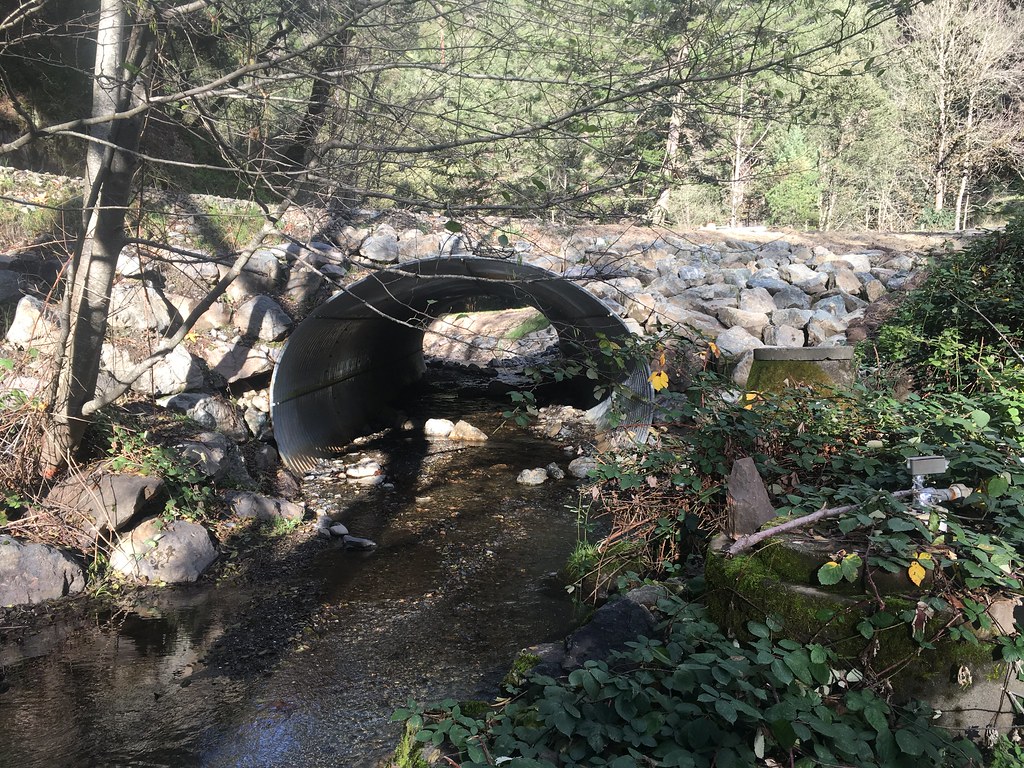
This project replaced a failing undersized corrugated metal pipe culvert on Galaxy Drive, which had blocked Sharber-Peckham Creek — a Trinity River tributary near Salyer in Trinity County — for at least 20 years. The barrier was replaced with a 12-by-14-foot embedded multi-plate ellipse culvert designed to pass 100-year flows while maintaining a natural streambed. Sharber-Peckham Creek is the greatest single producer of coho salmon between the Hoopa reservation and the North Fork Trinity River, and post-project monitoring found 740 juvenile coho rearing upstream within one year.
Location: Sharber-Peckham Creek is a tributary to the mainstem Trinity River, located approximately 0.2 miles upstream from the Trinity River confluence near Salyer, Trinity County, California. The Trinity River is a major tributary to the Klamath River, which flows to the Pacific Ocean in Del Norte County. The project site is approximately 70 miles downstream of Lewiston Dam and the Trinity River Hatchery.
Historical Presence of Anadromous Fish: The Southern Oregon Northern California Coho Recovery Plan describes Sharber-Peckham Creek as having one of the strongest populations of coho salmon in the Lower Trinity River, and identifies it as the single greatest producer of coho salmon between the Hoopa Tribe reservation and the North Fork Trinity River. The creek also supports Upper Klamath-Trinity Rivers Chinook salmon and Klamath Mountains Province steelhead. The low-gradient channel, spring-fed perennial flows, and broad floodplain offer exceptional cold water refugia, spawning, and overwintering habitat, with minimal influence from hatchery strays compared to upper Trinity reaches.
Project Lead Organization: Five Counties Salmonid Conservation Program (5C) / Northwest California Resource Conservation and Development Council
Project Partners: Six Rivers National Forest (USFS); NOAA Fisheries, Northern California Office; California Department of Fish and Wildlife; U.S. Fish and Wildlife Service; California State Coastal Conservancy; U.S. Army Corps of Engineers; Trinity County; local landowners
Funding from the California Fish Passage Forum: The California Fish Passage Forum – Fish Habitat Partnership contributed $39,998 toward the project. Total project financing was $297,230, with additional funding from the California State Coastal Conservancy ($68,545), CDFW Fisheries Restoration Grant Program ($102,749), and U.S. Fish and Wildlife Service ($85,938).
Project Description: For at least 20 years, a 4-foot diameter undersized corrugated metal pipe culvert on Galaxy Drive created a 3-foot outlet jump combined with a steep pipe gradient of 4.9%, constituting a complete jump and velocity barrier to salmonids at the majority of flows. US Forest Service fisheries biologists documented adult coho and steelhead congregating at the culvert outlet attempting to migrate upstream throughout this time. The project replaced the barrier culvert with a 12-foot by 14-foot multi-plate horizontal ellipse embedded CMP culvert, designed to pass the 100-year flood while maintaining a natural streambed and channel width.
Expected Completion: Fall 2016
Project Effectiveness: In 2017, monitoring conducted by the U.S. Forest Service identified 740 juvenile coho rearing upstream of the project site, a dramatic demonstration of fish rapidly colonizing the newly opened 1.2 miles of spawning and rearing habitat following barrier removal.