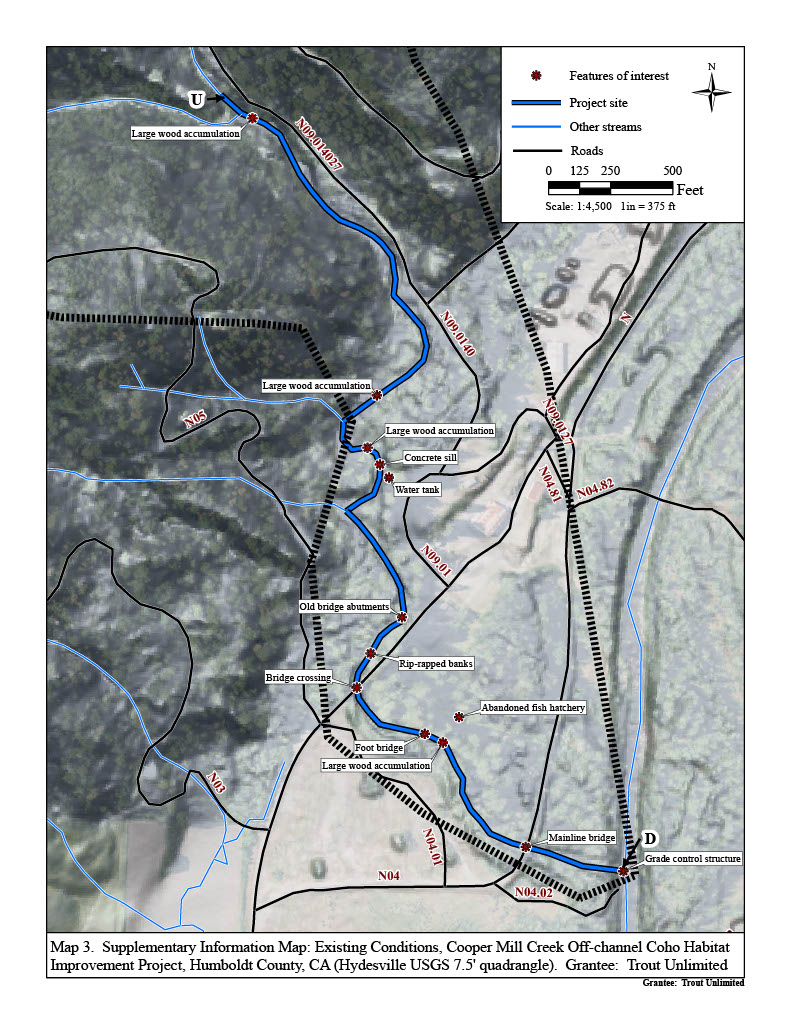
This project funded site characterization and engineering design work for two legacy fish passage barriers on lower Cooper Mill Creek, a tributary to Yager Creek within the Van Duzen River basin in Humboldt County — a boulder step-weir complex at the creek mouth and a concrete sill approximately 0.5 miles upstream. Hydraulic modeling confirmed both structures block adult and juvenile salmonids at most flows. The designs will support future physical removal of barriers to coho salmon, Chinook salmon, and steelhead in a historically productive watershed.
Location: Cooper Mill Creek is a 3.9-square-mile sub-watershed of Yager Creek, located approximately 2.5 miles upstream of the Yager Creek/Van Duzen River confluence. The Van Duzen is a major tributary of the Eel River. The project targets two fish barrier structures within the lower 0.5 miles of Cooper Mill Creek on property managed by Humboldt Redwood Company (HRC). Humboldt County, CA.
Historical Fish Presence: Cooper Mill Creek contains 3.0 miles of anadromous habitat and has historically supported Coho salmon (Oncorhynchus kisutch), Chinook salmon, and steelhead trout (O. mykiss). Historical surveys from 1961 recorded abundant salmonid fry, including silver (Coho) fry, with observers noting that Cooper Mill Creek could be an important contributor to the Yager Creek fishery. A fish hatchery was historically operated on the creek, and steelhead stocking occurred through the 1980s. The Yager Creek subbasin is considered among the most important Coho and Chinook salmon watersheds in the Van Duzen River basin.
Project Lead: Trout Unlimited – North Coast Coho Project
Project Partners: Pacific Watershed Associates (PWA); Humboldt Redwood Company (HRC); California Department of Fish and Wildlife (CDFW)
CFPF Funding: $65,782
Project Description: Two legacy structures on lower Cooper Mill Creek — a boulder step-weir complex at the creek’s confluence with Yager Creek, and a concrete sill associated with an old water diversion approximately 0.5 miles upstream — were identified as partial to complete barriers to salmonid migration. This project funded the preliminary site characterization work needed to develop final engineered fish passage designs. Work included geomorphic mapping, subsurface stratigraphy characterization, topographic and longitudinal channel profile surveys, hydraulic modeling (HEC-RAS), stream stage monitoring, and a biological fish passage assessment. Hydraulic modeling confirmed that both structures are barriers to adult and juvenile Coho at most flow conditions, with the concrete sill being a barrier at all modeled flows.
Expected Completion: September 2019 (site characterization phase). Full 100% engineering designs were to be completed under the companion CDFW FRGP grant, with a design review target of June 2020.
Project Effectiveness: This grant funded the design and characterization phase only — no physical fish passage improvements were constructed under this contract. Post-construction monitoring results are not available from this report. Snorkel surveys conducted in fall 2019 confirmed that both structures were impassable to salmonids at low flow, with only one juvenile Coho and young-of-year/1+ steelhead observed below the barriers. No Sacramento pikeminnow were detected in Cooper Mill Creek.