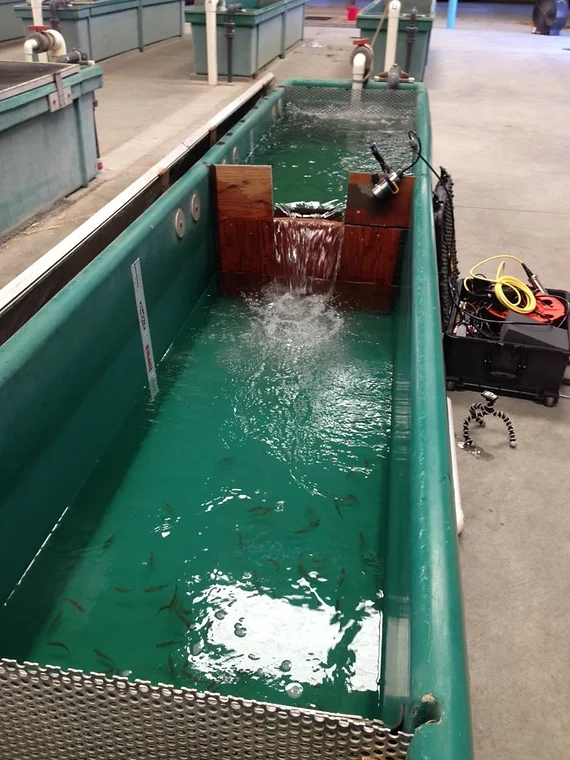
This research project tested the leaping abilities of juvenile steelhead and coho salmon ranging from 40–130mm at the Warm Springs Fish Hatchery on Dry Creek in Sonoma County, using a flume with waterfall heights of 6, 12, and 18 inches. Four experiments examined waterfall height, fish size, species differences, and water temperature. Findings directly informed the 2019 NMFS Guidelines for Salmonid Passage at Stream Crossings, including an increase in the allowable maximum hydraulic drop for juvenile salmonids from 6 to 12 inches.
Location: Experiments were conducted at the U.S. Army Corps of Engineers’ Don Clausen Warm Springs Fish Hatchery in Geyserville, CA. The hatchery is located on Dry Creek, a tributary to the Russian River in Sonoma County. Test fish were hatchery-reared steelhead and coho salmon produced from crosses of adults returning from Dry Creek, of both wild and hatchery origin.
Historical Presence of Anadromous Fish: The research subjects were steelhead (Oncorhynchus mykiss) and coho salmon (Oncorhynchus kisutch) from the Russian River watershed. Both species are federally listed — Central California Coast coho salmon as endangered and Central California Coast steelhead as threatened. The Russian River is one of the most important coastal salmonid watersheds in California, supporting some of the last remaining wild coho populations in the state.
Project Lead Organization: NOAA Fisheries, West Coast Region, California Coastal Area Office.
Project Partners: U.S. Army Corps of Engineers, Warm Springs Fish Hatchery (provided facilities and fish for experiments).
Funding from the California Fish Passage Forum: $13,008.28
Project Description: State and federal agencies held inconsistent design guidelines for maximum allowable jump heights at juvenile salmonid fish passage facilities — a gap in knowledge that risked costly over-engineering of fish passage structures or inadvertent blocking of habitat. To address this, researchers tested the leaping abilities of juvenile hatchery-reared steelhead and coho salmon (40–130mm fork length) using a test flume equipped with waterfalls of 6-inch, 12-inch, and 18-inch heights at the Warm Springs Fish Hatchery. Four experiments were conducted: (1) effects of waterfall height and fish size on passage; (2) comparison between species; (3) effects of two 6-inch jumps in series versus one 12-inch jump; and (4) effects of water temperature. Experiments ran from June 2014 through January 2019.
Expected Completion: Spring 2019.
Project Effectiveness (Research Findings): The study found that for steelhead at 54°F, no fish smaller than 47mm successfully passed a 6-inch waterfall and no fish smaller than 57mm passed a 12-inch waterfall. Passage success was approximately 20% higher over 6-inch jumps versus 12-inch jumps for fish between 50–100mm, but there was no significant difference for fish over 100mm. No fish of any size successfully leaped an 18-inch waterfall. Passage success was similar for coho and steelhead and decreased with colder water temperatures. In September 2019, the NMFS Southwest Region reissued the Guidelines for Salmonid Passage at Stream Crossings, and the findings of this project helped inform updates in the 2019 Addendum, which included adjustments to the design criteria — including increasing the maximum hydraulic drop for juvenile salmonids from 6 inches to 12 inches as a general guideline.