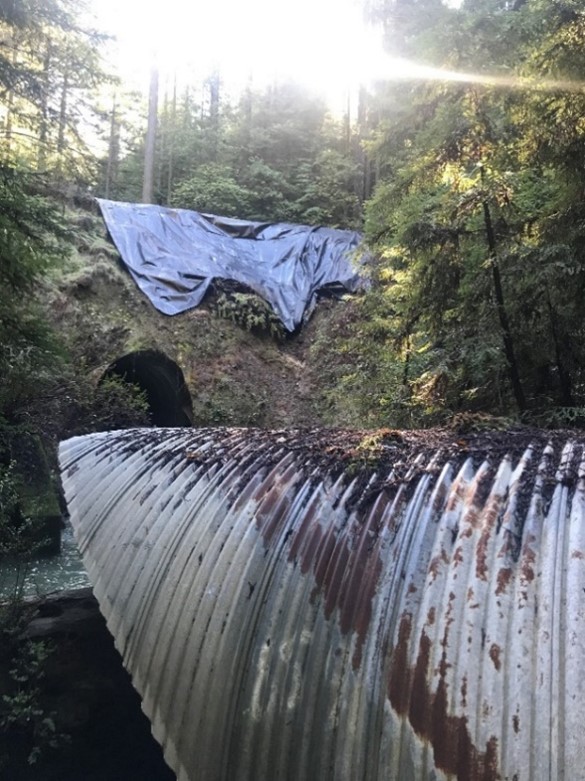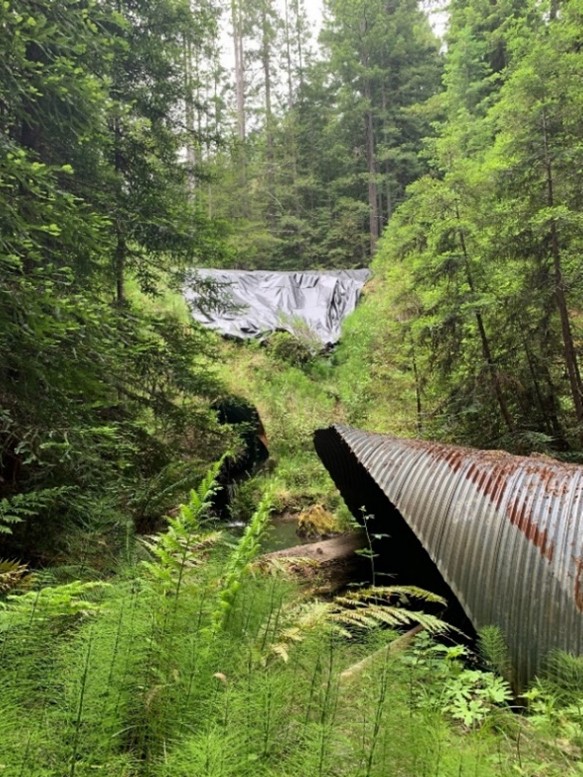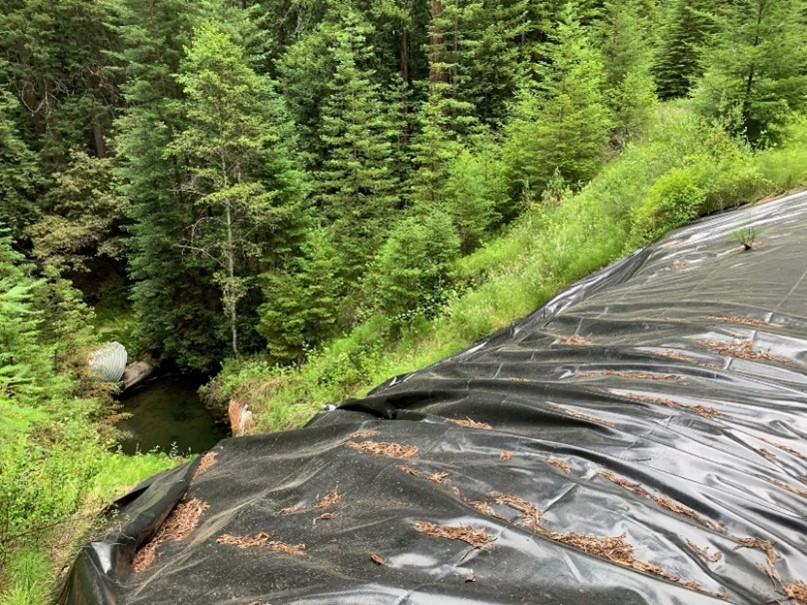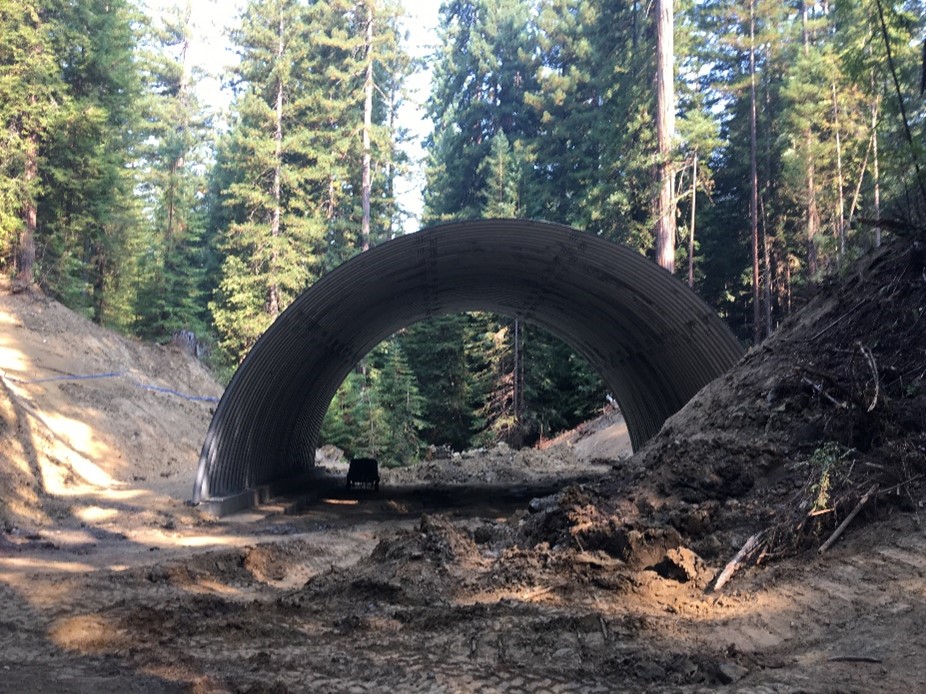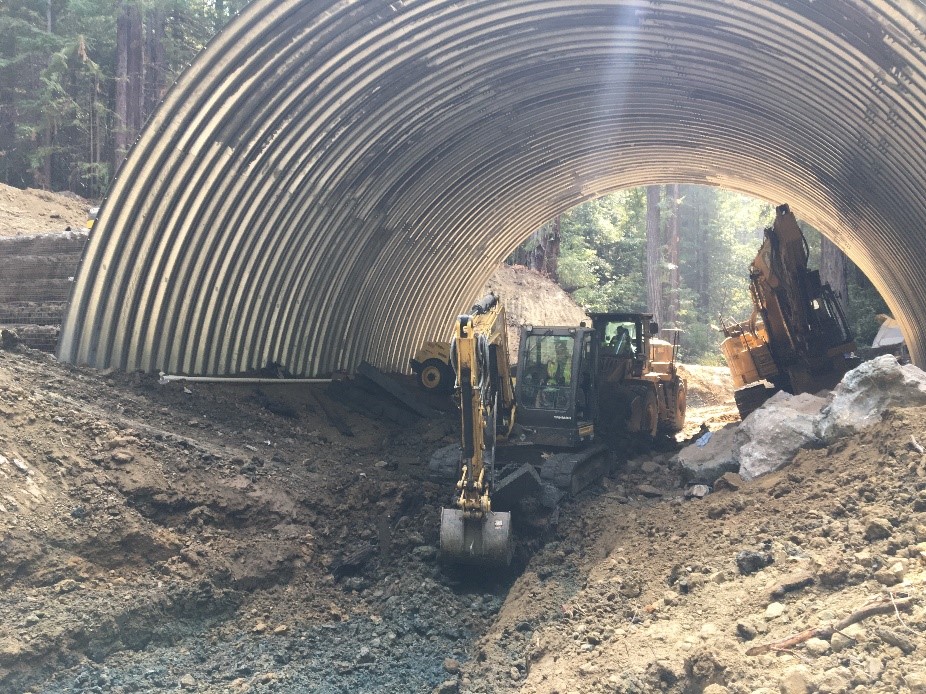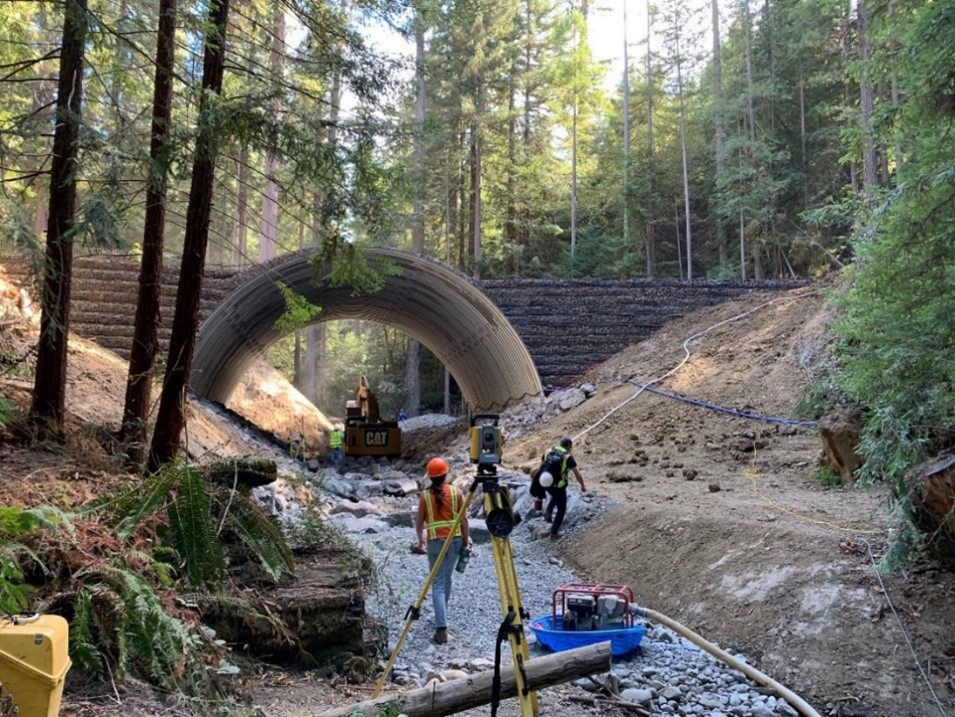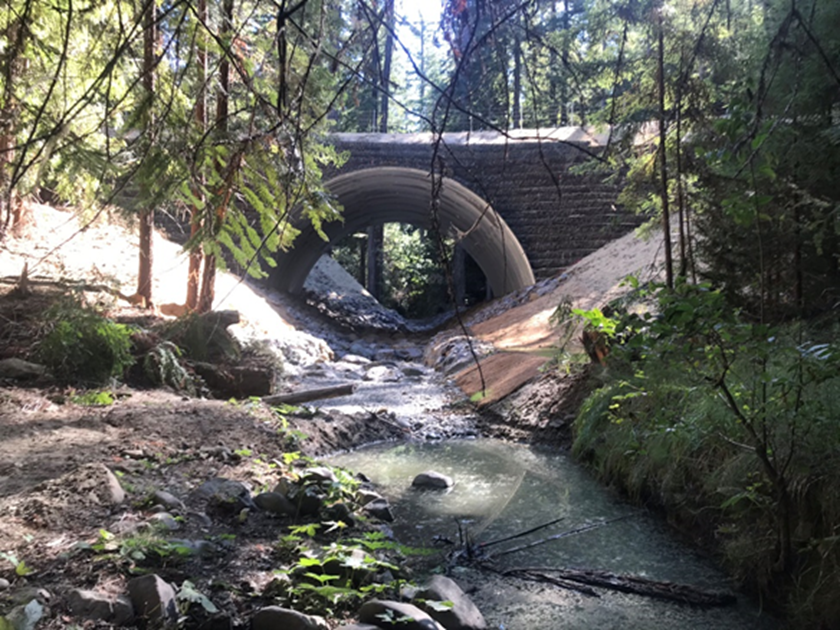
This project replaced a failing, undersized 9-foot culvert on the Mendocino Railway (Skunk Train) line with a 50-foot span corrugated steel arch structure to restore fish passage and eliminate a total barrier to migrating salmonids on the upper Noyo River in Mendocino County, California. In addition to opening 0.5 miles of steelhead and Coho salmon rearing habitat, the project prevented an estimated 8,400 cubic yards of sediment from being released into the Noyo River headwaters, protecting aquatic resources along approximately 3 miles of downstream habitat.
Location: Upper Noyo River watershed, Mendocino County, California. The Noyo River flows westward through Mendocino County, draining into the Pacific Ocean at Fort Bragg. The project site is in a remote area accessible only by rail or trail.
Historical Fish Presence: The Noyo River and its upper watershed support Central California Coast (CCC) Coho salmon and North Coast steelhead trout, with Chinook salmon present to a lesser extent. The upper Noyo is recognized as high-quality rearing habitat for steelhead and Coho salmon. Pre-project field surveys by fisheries consultant Ross Taylor confirmed 0.5 miles of high-quality rearing habitat upstream of the barrier.
Project Lead: Trout Unlimited – North Coast Coho Project
Project Partners: Mendocino Rail / Mendocino Railway (Skunk Train); Mendocino Land Trust (landowner); Wildlife Conservation Board (co-funder, Prop. 68); NOAA Community-Based Restoration Center (co-funder); Michael Love and Associates; AECOM; Granite Construction (contractor). Subcontractors for environmental compliance: North Coast Resource Management (rare plant/botany), Salix Natural Resource Management (Northern Spotted Owl surveys), Forest Ecosystems Management (NSO reporting), Ross Taylor and Associates (fisheries monitoring and fish relocation).
CFPF Funding: $15,000
Project Description: The 100-year-old railway crossing at Milepost 28.8 had been partially replaced in the 1990s with a 9-foot circular culvert, which was hydraulically undersized and in poor structural condition — with the downstream pipe section separated due to outlet undermining and the fill prism at risk of catastrophic failure. The crossing functioned as a total barrier to fish passage. The project replaced the culvert and failing fill with a 50-foot span “Super Cor” corrugated steel plate arch structure on precast concrete footings, with an engineered streambed constructed inside. Environmental compliance surveys included rare plant, Northern Spotted Owl, nesting bird, and cultural resources investigations. Fish and amphibian relocation was conducted July 6–7, 2020 prior to construction. Materials had to be transported by rail to the remote site, requiring the Mendocino Railway to cancel passenger service on weekends to facilitate deliveries.
Expected Completion: Fall 2020.
Project Effectiveness: The project eliminated a total fish passage barrier and restored access to 0.5 miles of high-quality steelhead and Coho salmon rearing habitat in the upper Noyo River. Critically, it also averted the potential release of approximately 8,400 cubic yards of fine sediment into the Noyo River headwaters — a volume estimated to have caused up to 1 foot of sedimentation across approximately 3 miles of downstream Coho, steelhead, and Chinook habitat.