This project used acoustic telemetry monitoring of White Sturgeon in the San Joaquin River Restoration Area to directly inform the design of fish passage improvements at the Eastside Bypass Control Structure (EBCS) in Merced County. By tracking when, where, and how adult White Sturgeon move through the restoration area relative to the EBCS — a gated flood control structure identified as a low-flow passage barrier — the project aimed to ensure that planned structural modifications and a new engineered rock ramp are designed to facilitate upstream migration by White Sturgeon, Green Sturgeon, Chinook salmon, and other native fishes in the Central Valley.
Location: The Eastside Bypass Control Structure (EBCS) is located in Merced County on the Eastside Bypass, a flood control channel that is part of the Lower San Joaquin River Flood Control Project. The EBCS sits within Reach 5 of the San Joaquin River Restoration Program (SJRRP) Restoration Area, which spans the San Joaquin River from Friant Dam to the confluence with the Merced River near Hills Ferry. The Eastside Bypass serves as an alternative migration corridor connecting the mainstem San Joaquin River with the upper restoration reaches and is a critical pathway for native fish attempting to access restored habitat above the Merced River confluence.
Historical Fish Presence: The San Joaquin River historically supported robust runs of spring-run Chinook salmon (O. tshawytscha) as well as White Sturgeon (A. transmontanus) and the threatened southern distinct population segment of Green Sturgeon (A. medirostris). Spring-run Chinook were extirpated from the San Joaquin River above the Merced River confluence following construction of Friant Dam in 1942, which blocked access to over 60 miles of river channel. The SJRRP documented its first returning adult spring-run Chinook in 2019, marking a significant recovery milestone. White Sturgeon are confirmed users of the restoration area, with individuals detected at Hills Ferry and, through this project, as far as 7.5 miles upstream. Green Sturgeon, a federally threatened species, were first documented in the Restoration Area in 2019.
Project Lead: U.S. Fish and Wildlife Service (USFWS), Lodi Fish and Wildlife Office (LFWO)
Project Partners: California Department of Fish and Wildlife (CDFW, La Grange office), San Joaquin River Restoration Program (SJRRP), U.S. Bureau of Reclamation, California Department of Water Resources (DWR), Eastside Bypass Improvements working group, California Fish Tracking Consortium
CFPF Funding: $49,837
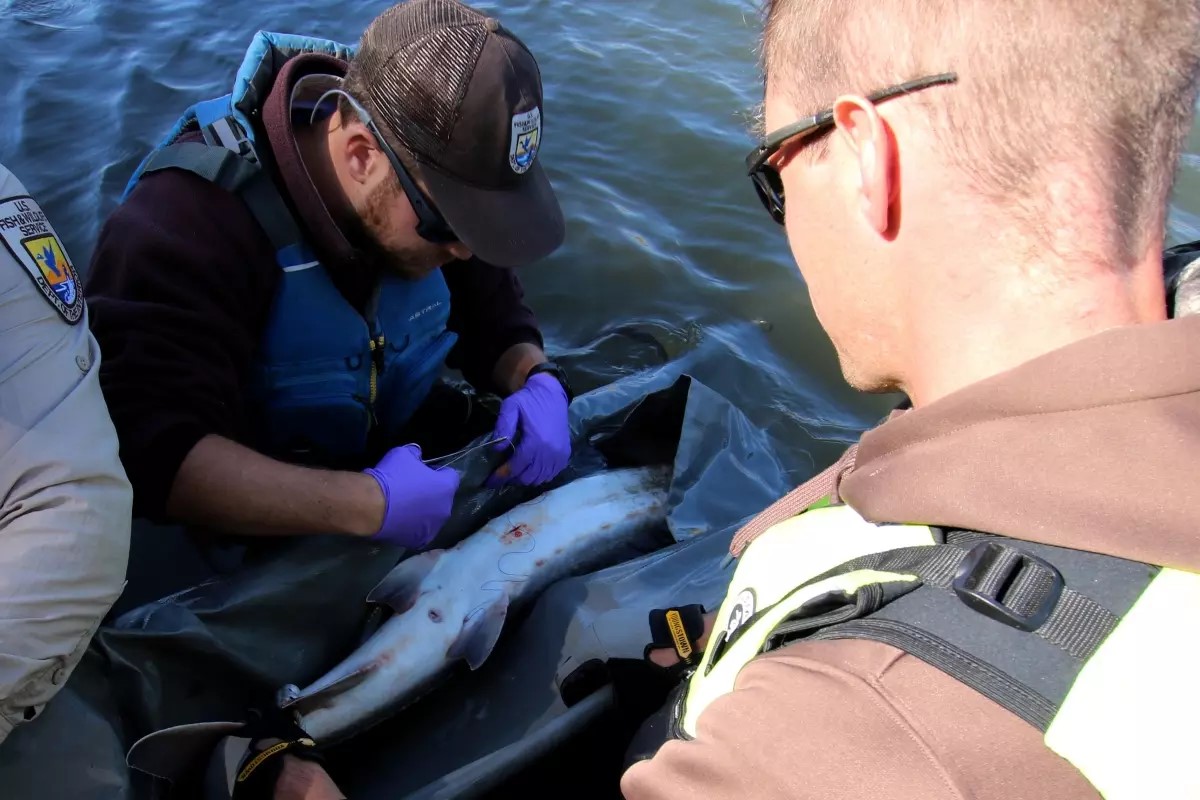
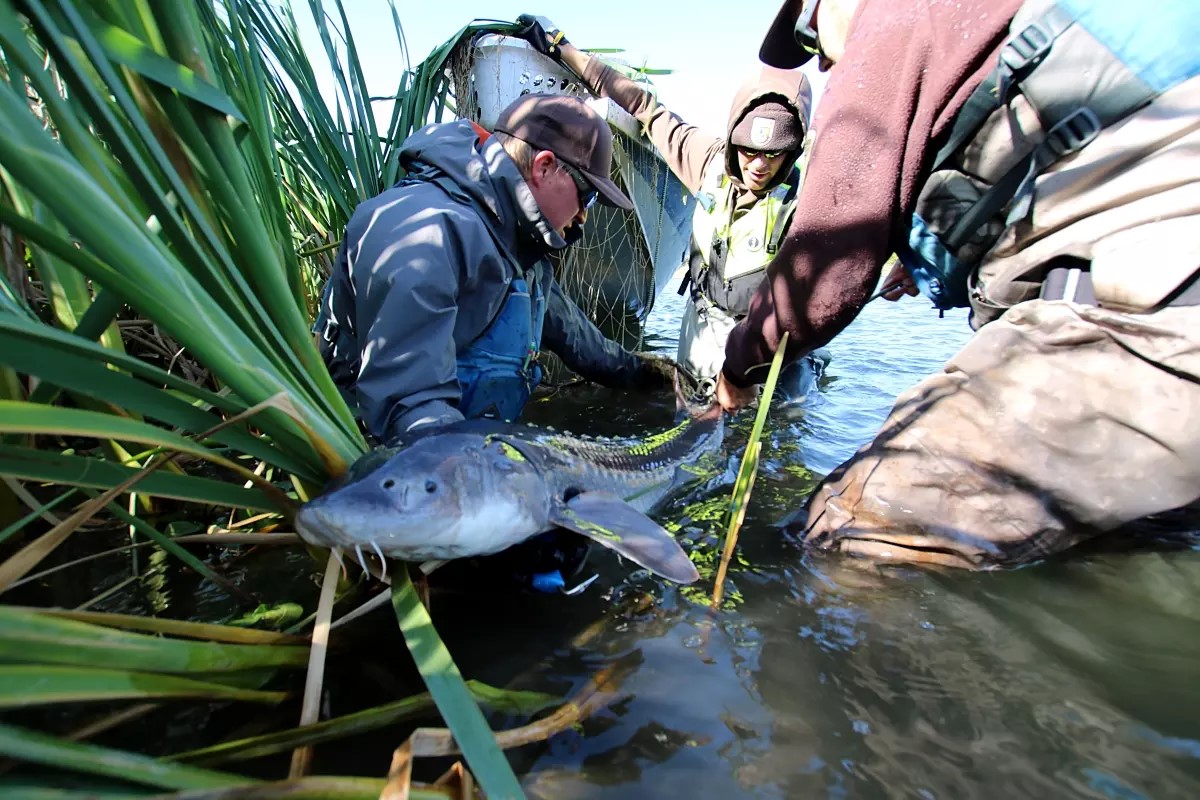
Project Description: The Eastside Bypass Control Structure is a gated structure that has been identified as a barrier to fish passage at lower flows within the SJRRP Restoration Area. DWR has planned modifications to the EBCS — including removal of a portion of the sill and energy dissipation blocks — and construction of an approximately 380-foot engineered rock ramp downstream of the structure to improve passage for salmonids, sturgeon, and lamprey while retaining flood control function. This project was designed to generate the biological data needed to ensure those design modifications are adequate for White Sturgeon specifically, as these bottom-dwelling fish have different passage requirements than salmon and cannot jump. Forum funding supported the extension of the existing 27-receiver acoustic telemetry array deeper into the Restoration Area, annual tagging of adult White Sturgeon using gill and trammel nets, receiver maintenance and data offloading in coordination with CDFW, and preparation of telemetry summary reports as deliverables. Key research questions addressed include: whether adult White Sturgeon currently use the Restoration Area; what their migratory behavior is between Hills Ferry and the EBCS; whether their movements correlate with flow and temperature conditions; and whether, after passage improvements are made, sturgeon are detected above the EBCS. Results are shared with the Eastside Bypass Improvements working group, the biennial SJRRP Science Meeting, and uploaded to the Hydra database maintained by the California Fish Tracking Consortium. Sturgeon tagging planned for spring 2023 was cancelled due to flood flows on the San Joaquin River that made field conditions unsafe; tagging was rescheduled for March 2024.
Expected Completion: Fall 2024
Project Effectiveness: During the reporting period, USFWS leveraged cost-shares to maintain the 27-receiver array and produced the attached White Sturgeon telemetry summary report as a Phase 1 deliverable. A previously tagged female White Sturgeon was detected at Valley Grasslands State Park in January 2023, confirming sturgeon penetration at least 7.5 river miles into the Restoration Area — the furthest upstream detection to date. The most upstream receiver, downstream of the Kelley Weir, could not be offloaded due to high flows, leaving open the possibility of even further upstream movement. The combined LFWO and CDFW receiver networks also successfully detected the holding and outmigration of a tagged Green Sturgeon in 2022–2023. No post-construction monitoring data were available within the reporting period, as EBCS structural modifications were still in the planning and design phase.