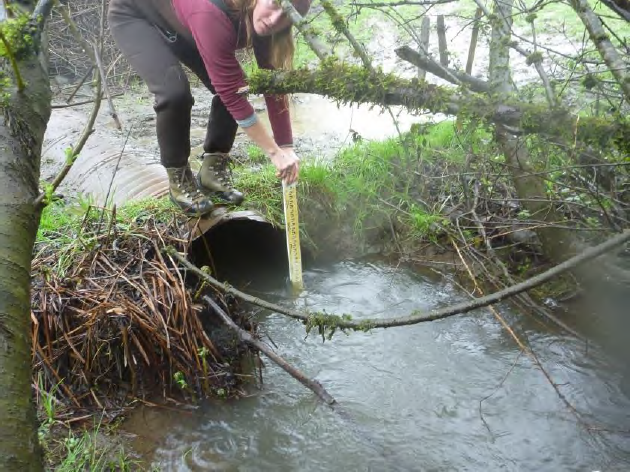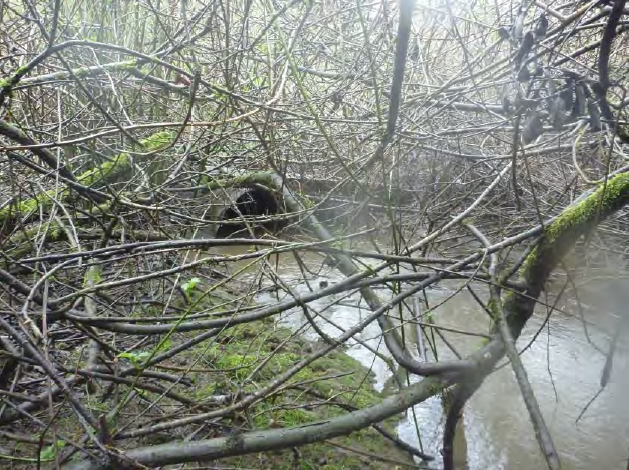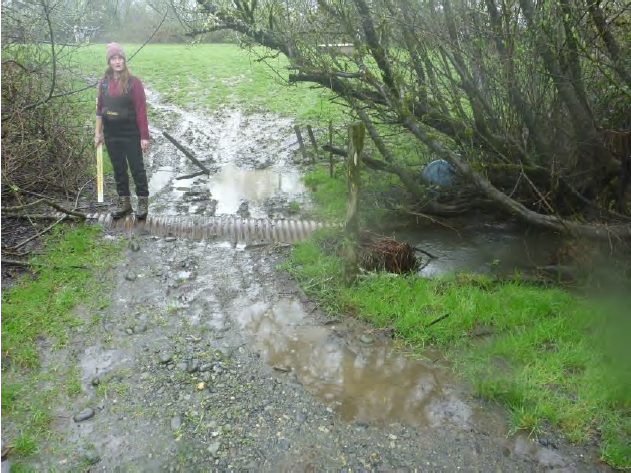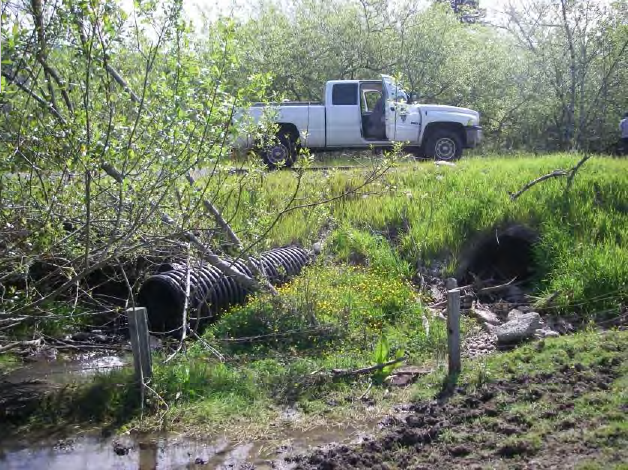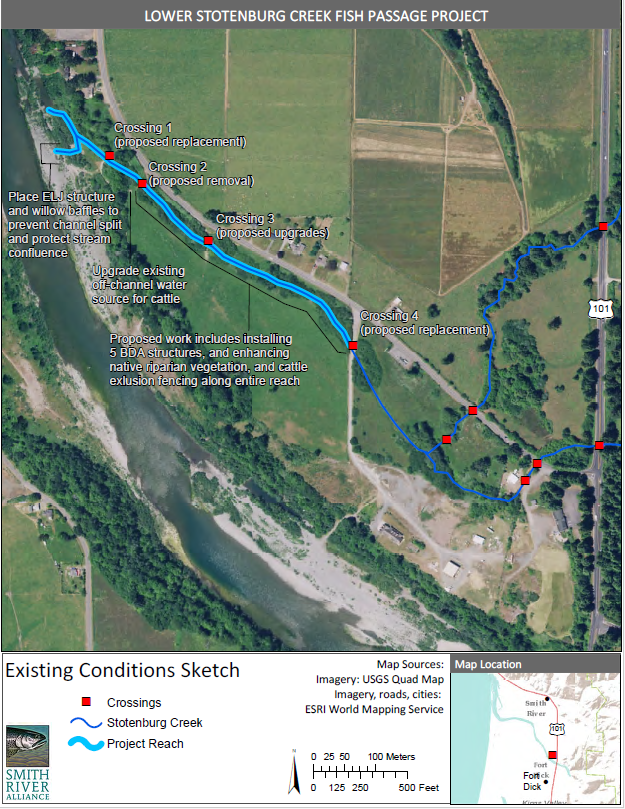
This project removed all fish passage barriers along the downstream-most 0.6 miles of Stotenburg Creek, a small tributary of the Smith River on the coastal plain of Del Norte County, by upgrading or removing four stream crossings and adding habitat complexity features. The work benefited threatened Southern Oregon/Northern California Coast coho salmon, Central Valley steelhead, coastal cutthroat trout, Chinook salmon, and Pacific lamprey by opening critical non-natal winter rearing habitat and reconnecting the creek to the mainstem Smith River.
Location: Stotenburg Creek, a small Smith River Plain tributary with a watershed area of 452 acres, located near the junction of South Fred D. Haight Drive and US Highway 101 in Del Norte County. The creek flows into the Smith River near its estuary, making it the most upstream tributary on the Smith River coastal plain. The project treated a 0.6-mile reach from the confluence of Stotenburg Creek with the Smith River upstream to Cedar Lodge Lane (the fourth crossing from the mouth).
Historical Fish Presence: Stotenburg Creek has been documented as providing important non-natal winter rearing habitat for juvenile coho salmon. Prior to the project, fish barriers limited access to this habitat. Post-project monitoring detected 173 juvenile coho salmon at the newly accessible project site during the winter of 2023–2024, as well as 29 juvenile Chinook salmon — the first documented occurrence of that species in Stotenburg Creek. The Smith River system is recognized as a Salmon Stronghold and supports populations of coho salmon, Chinook salmon, steelhead, coastal cutthroat trout, and Pacific lamprey.
Project Lead: Smith River Alliance
Project Partners: California Department of Fish and Wildlife (CDFW), NOAA Fisheries, U.S. Fish & Wildlife Service (USFWS), private landowners
CFPF Funding: $49952.2
Project Description: Stotenburg Creek contained four fish passage barriers at road crossings that prevented salmonid access to productive winter rearing habitat on the Smith River coastal plain. The project addressed all four barriers through a combination of approaches: Crossing #1 was converted to a bridge with a natural channel bottom; Crossings #2 and #3 were fully removed and restored to natural channel; and Crossing #4 at Cedar Lodge Lane had four undersized culverts replaced with a single aluminum box culvert (23’10” wide, 10′ high) embedded three feet below natural channel grade and backfilled with native streambed material to create a natural swim-through channel. Additional habitat complexity measures included installation of an engineered log jam, large wood structures, five beaver dam analogs to increase winter rearing habitat, channel recontouring to improve connectivity with the Smith River mainstem, native riparian planting, and cattle exclusion fencing. Adaptive management was also performed at a confined channel section upstream of the bridge installed in 2023, with minor widening completed in coordination with CDFW to prevent scour-related passage barriers from developing.
Expected Completion: Fall 2024
Project Effectiveness: Post-project biological monitoring demonstrated rapid and significant salmonid use of the newly accessible reach. During the winter of 2023–2024, 173 juvenile coho salmon and 29 juvenile Chinook salmon — the first documented Chinook in Stotenburg Creek — were detected at the project site. Both species were again detected in winter 2024–2025, confirming consistent use of the restored habitat. Project photos were collected during high-flow (winter) and low-flow (spring) conditions to evaluate physical effectiveness. Riparian plantings were completed and maintained by the riparian contractor through the reporting period.