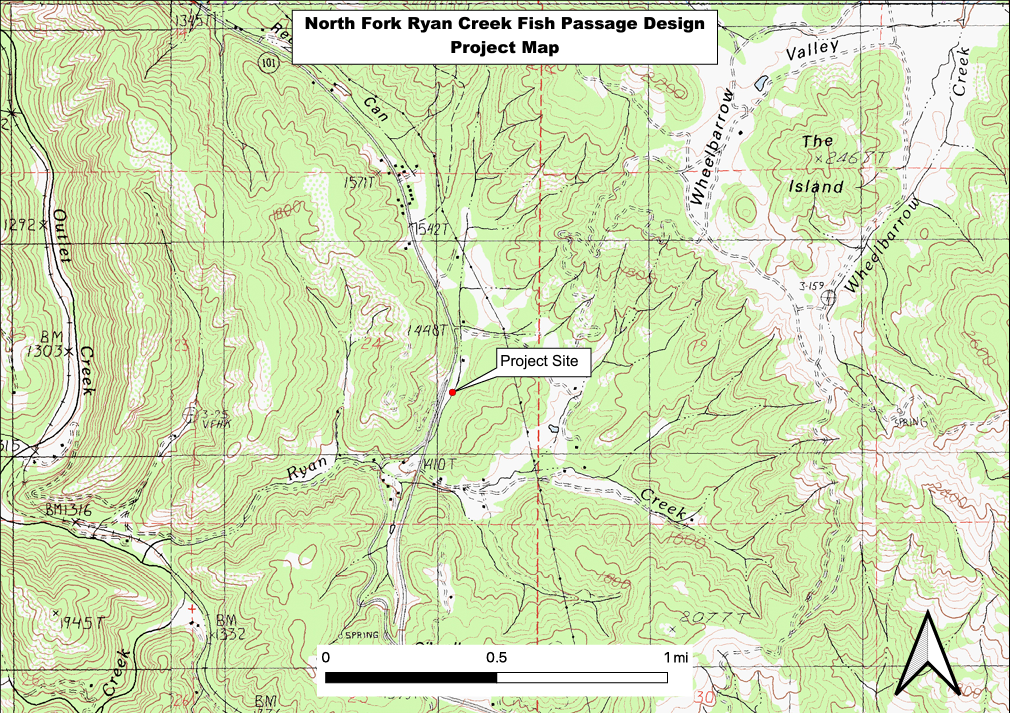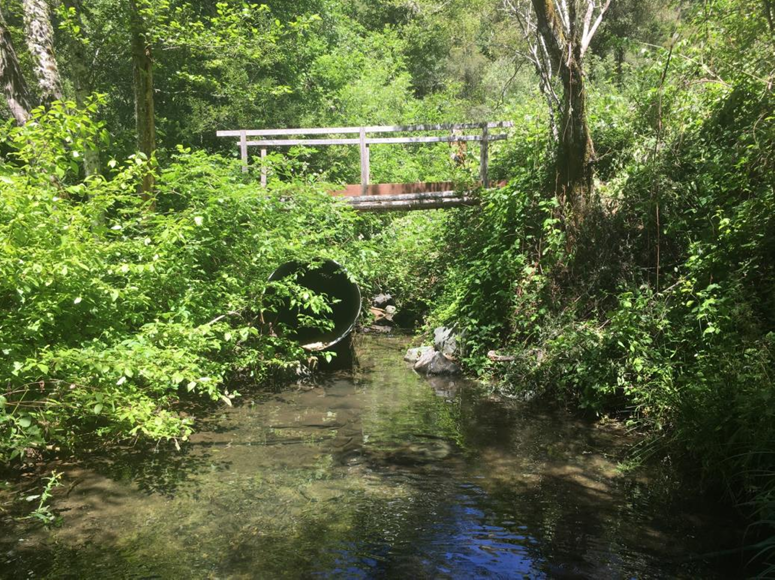
This project produced engineering designs to replace a blown-out culvert and rock weir barrier on North Fork Ryan Creek — a tributary to Outlet Creek and the Eel River — near Willits in Mendocino County, to restore fish passage for Coho salmon and steelhead trout at all life stages.
Location: North Fork Ryan Creek, a tributary to Ryan Creek, which flows into Outlet Creek and ultimately the mainstem Eel River, near Willits, Mendocino County. The project site is located at a private road crossing approximately 1,740 feet upstream from the Ryan Creek confluence (39.48354°N, -123.36064°W). Outlet Creek is a tributary to the mainstem Eel River north of Willits. The Outlet Creek Basin drains 160 square miles of Mendocino County’s Coast Range and is one of the headwaters of the Eel River, California’s third largest river system.
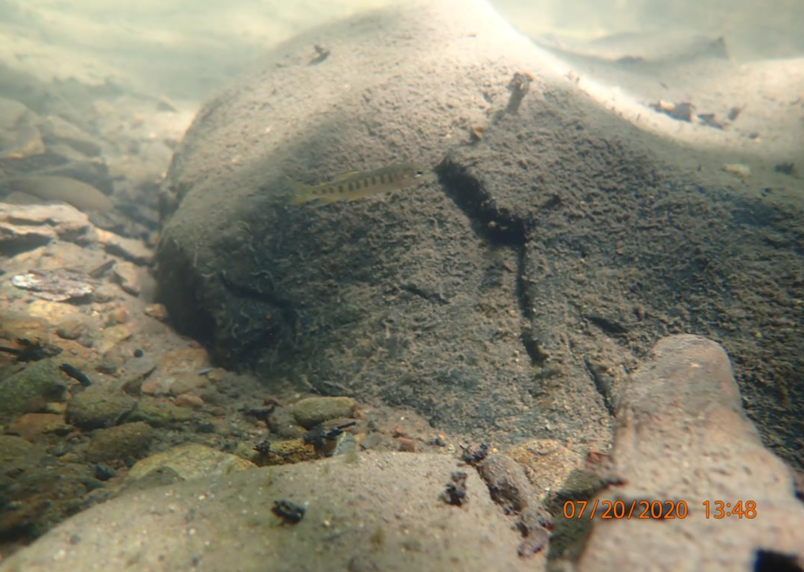
Historical Fish Presence: The Ryan Creek watershed supports spawning and rearing habitat for Coho salmon and steelhead trout. DFG stream survey reports document the presence of juvenile steelhead in Ryan Creek, a tributary to Outlet Creek, and adult Coho salmon carcasses were recorded in Ryan Creek during 1987–1989. Chinook salmon, Coho salmon, and steelhead have all seen dramatic declines in historic populations and are currently listed as threatened under the federal Endangered Species Act.
Project Lead: Eel River Watershed Improvement Group (ERWIG)
Project Partners: Munselle Civil Engineering (engineering subcontractor); California Department of Fish and Wildlife (CDFW) and NOAA (design review); private landowner
CFPF Funding: $65,500
Project Description: Two culverts at a private road crossing on NF Ryan Creek had blown out, leaving behind a combined barrier — one remaining culvert plus a rock weir with a 1.9-foot plunge pool — that acted as a temporal barrier to adult salmonids and a total barrier to juvenile salmonids. This project funded the complete engineering design of a new crossing to replace the barrier, including topographic survey, hydraulic analysis, conceptual and final designs (through 100%), a Basis of Design report, bridge designs, and a probable construction cost estimate. The completed designs were shared with the landowner, CDFW, and NOAA for review. ERWIG intends to seek separate grant funding to implement the construction.
Expected Completion: Winter 2024
Project Effectiveness: No post-completion monitoring data is available at this time, as this was a design-only project.