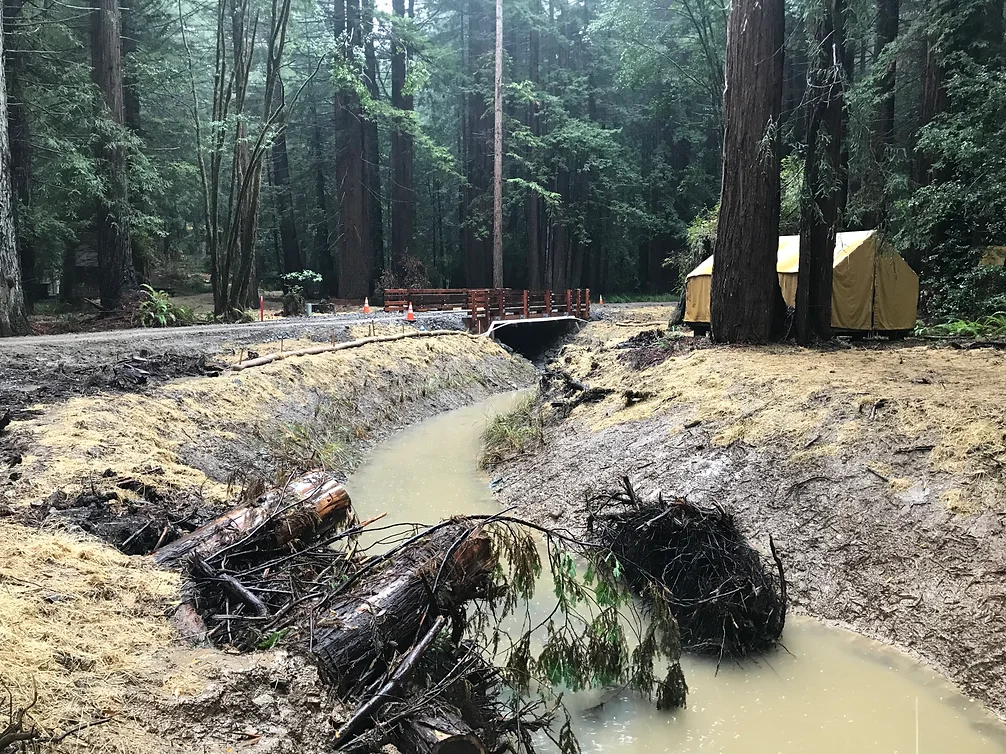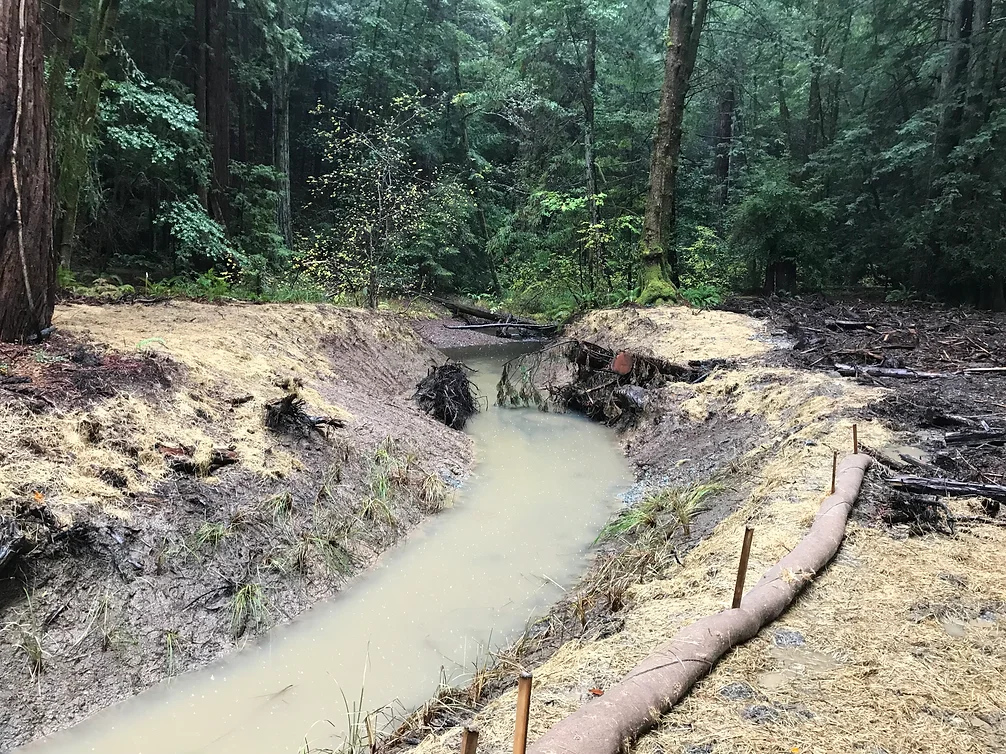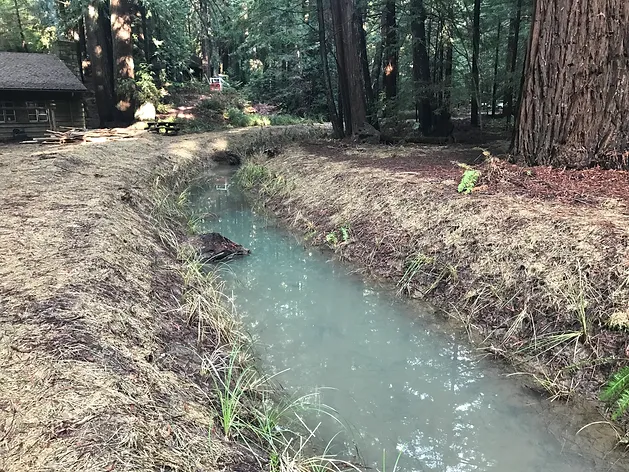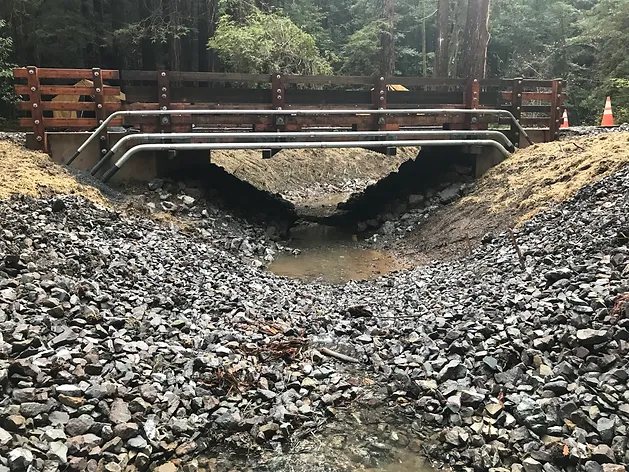
This project replaced a failing road-stream crossing on Camp Road in Manly Gulch — a tributary to the Little North Fork of the Big River flowing through Mendocino Woodlands State Park in Mendocino County — with a 30-foot span timber bridge and realigned approximately 600 feet of channel. Log steps, pools, boulder weirs, rootwads, and a backwater alcove were installed to improve habitat. The project opened approximately 4,000 feet of upstream habitat for federally endangered coho salmon and threatened steelhead, species for which Manly Gulch is designated critical habitat.
Location: Manly Gulch is a tributary to the Little North Fork of the Big River, located approximately 12 miles upstream from the mouth of the Big River near the Village of Mendocino. The creek flows through Camp 3 of Mendocino Woodlands State Park. Mendocino County, California.
Historical Fish Presence: Coho salmon and steelhead trout. Both species are listed under the Federal Endangered Species Act; Coho salmon carry additional listing as endangered under the California ESA. Manly Gulch is designated critical habitat for both species.
Project Lead: Trout Unlimited – North Coast Coho Project
Project Partners: California Department of Fish and Wildlife (CDFW, primary funder); California Department of Parks and Recreation (CDPR, lead agency for contractor selection and administration); NOAA; Michael Love & Associates, Inc. (project engineer); Hanford ARC (contractor)
CFPF Funding: $54,765
Project Description: A failing road-stream crossing on Camp Road was blocking Coho salmon access to approximately 4,000 feet of upstream habitat in Manly Gulch, while also causing chronic sediment aggradation, channel instability, multiple temporary channels, and frequent overbank flooding at flows as low as 10 cfs. The project replaced the crossing with a 30-foot span timber glulam slab bridge and realigned approximately 600 feet of channel — 400 feet upstream of Camp Road and 200 feet downstream — to reconnect Manly Gulch directly to the Little North Fork of the Big River. Channel improvements included installation of 12 log steps, 10 pools, a boulder weir, rootwads, and a backwater alcove at the confluence to provide velocity refugia for fish during high flows. Riparian revegetation included 301 native container plants and seed. Total project cost was $1,257,210.
Expected Completion: Spring 2019
Project Effectiveness: Post-construction monitoring was conducted and documented in the appendices. Hydraulic performance improved significantly — design-condition channel capacity now handles flows near the 5-year event (65 cfs) before out-of-bank flooding, compared to the pre-project threshold of 10 cfs. Periodic sediment aggradation in the lowest channel reaches due to backwater from the Little North Fork, indicates that occasional channel maintenance may be needed.