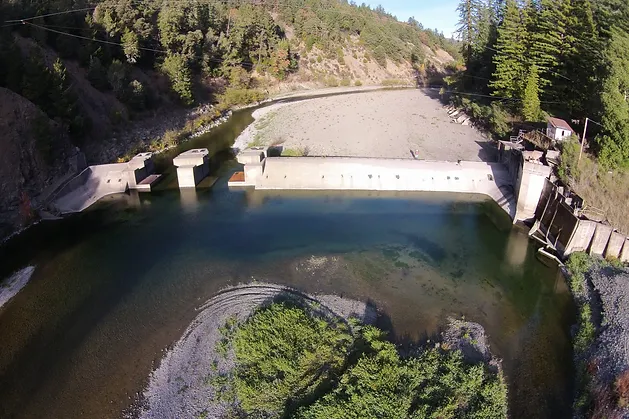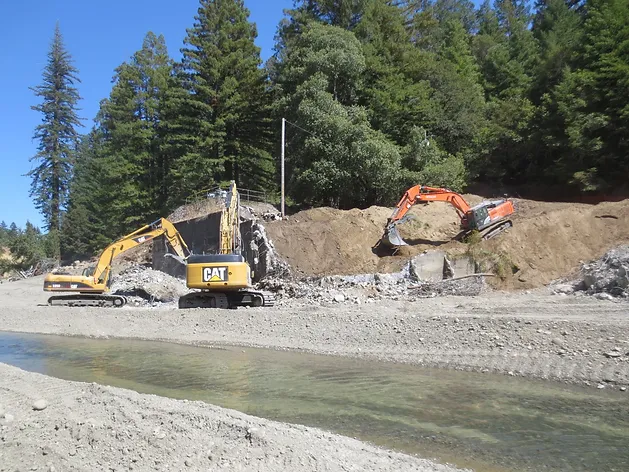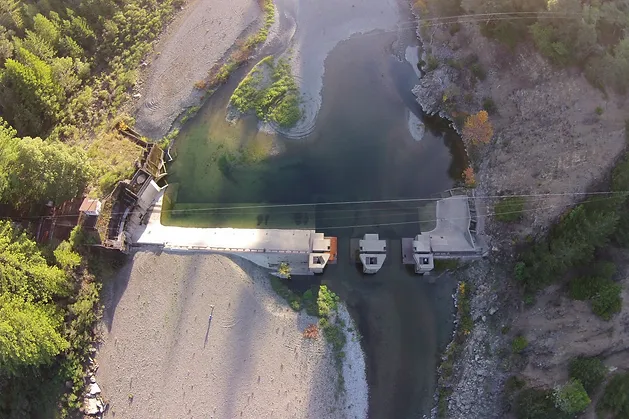
This project fully removed the Benbow Dam from the South Fork of the Eel River at Benbow Lake State Recreation Area, approximately two miles south of Garberville in Humboldt County. Originally built in the 1930s for power generation, the dam had become a safety hazard blocking upstream migration. Removal spanned two construction seasons (2016–2017) and included bank regrading and riparian revegetation. It was the second-largest dam removal in California history at the time, opening 100 miles of South Fork Eel River habitat to coho salmon, Chinook salmon, steelhead, and Pacific lamprey.
Location: Benbow Lake State Recreation Area on the South Fork of the Eel River, approximately 2 miles south of Garberville in southern Humboldt County, California. The South Fork Eel is a major tributary of the Eel River, one of California’s largest coastal river systems.
Historical Fish Presence: Coho salmon, Chinook salmon, steelhead trout, and Pacific lamprey. Fish counts at the Benbow dam between 1938 and 1973 reveal a declining trends for all salmonids. In the 1930s, salmonid populations passing the dam were estimated at approximately 20,000 Chinook and 15–17,000 Coho. By 2010, there were only 1,000 Chinook and 500 coho in this part of the river.
Project Lead: California Department of Parks and Recreation (California State Parks)
Project Partners: NOAA’s Restoration Center, American Rivers, and Questa Engineering Corp NOAA Fisheries for planning and engineering; Humboldt County (loaned railroad car bridges for site access); California Conservation Corps (native riparian revegetation).
CFPF Funding: $58,499.00
Project Description: The Benbow Dam, on the South Fork of the Eel River, had become a safety hazard and limited threatened Coho and Chinook salmon and steelhead from reaching upstream habitat. Built in the 1930s originally for power generation, the dam was in need of major repairs by the early 2000s. This project fully removed the dam structure — including shallow foundation sections, deep steel H-beams, and concrete caissons — over two construction seasons (2016 and 2017). Site work included bank regrading, erosion control blankets, and planting of willow, cottonwood, and alder poles along the riverbanks. It was the second-largest dam removal in California history when completed.
Expected Completion: Fall 2017.
Project Effectiveness: The removal opened 100 miles of stream on the South Fork Eel River to anadromous fish. Post-removal topographic surveys were completed in August 2017, documenting channel response. Vegetation monitoring was planned for at least three years following planting, with California State Parks conducting ongoing site monitoring. Fisheries response data collection was anticipated as part of the spring 2018 follow-up survey work.