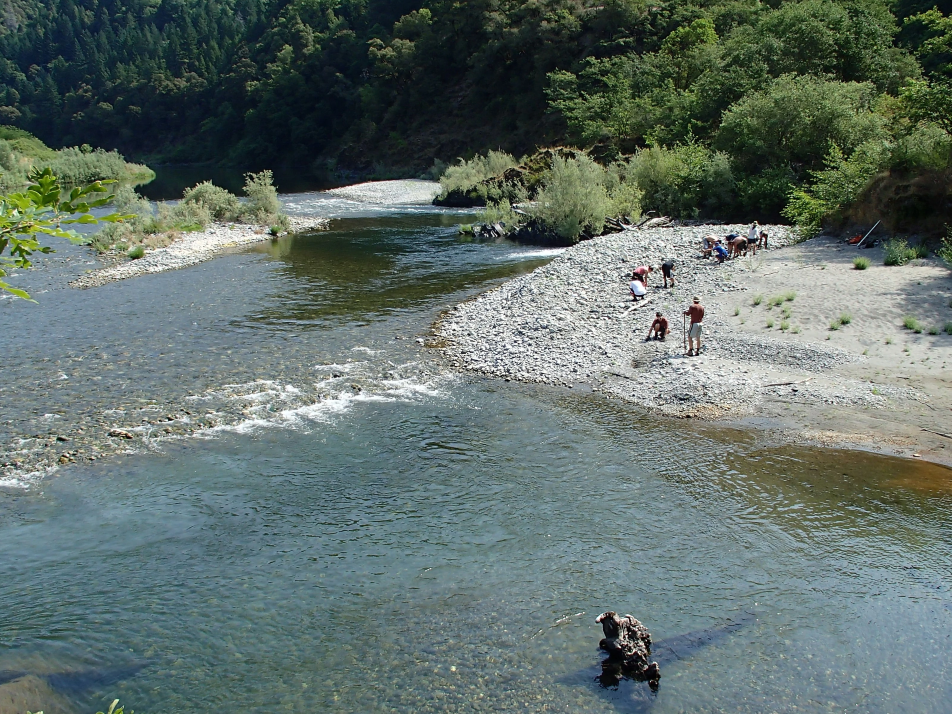
This ongoing annual project deploys trained crews each summer to assess and manually treat fish passage barriers at the mouths of up to 72 priority tributaries to the Klamath, Salmon, and Lower Scott Rivers across Humboldt and Siskiyou Counties. Barriers including debris jams, boulder cascades, and perched alluvial deltas are modified using hand tools to create step-pool fishways, and brush bundles installed to enhance thermal refugia. The project benefits coho salmon, Chinook salmon, and steelhead, with over 80% of treated sites showing documented increases in salmonid presence post-treatment by 2022.
Project Name: Mid Klamath Fish Passage Improvement Project
Location: Tributaries to the Klamath, Salmon, and Lower Scott Rivers across the Mid Klamath Subbasin, spanning from Weitchpec (Humboldt County) upstream to Cottonwood Creek (Siskiyou County). The project covers a broad geographic footprint, with crews assessing up to 72 creek mouths per season distributed across both counties.
Historical Fish Presence: Coho salmon (Oncorhynchus kisutch), Chinook salmon (O. tshawytscha), and steelhead trout (O. mykiss) are all present and historically abundant throughout the Klamath River system. Recent research in the Klamath Basin indicates that both summer and winter refugia associated with the lower reaches of tributaries are critical for the survival of juvenile salmonids, with fisheries surveys identifying consistently high numbers of juvenile salmonids in habitats that function as thermal refugia.
Project Lead: Mid Klamath Watershed Council (MKWC)
Project Partners: Karuk Tribal Fisheries Program (KTFP); Salmon River Restoration Council (SRRC); US Forest Service (Orleans Ranger District and Happy Camp/Oak Knoll Ranger District); US Fish & Wildlife Service.
CFPF Funding: $38,680.12
Project Description: Since 2001, MKWC, KTFP, SRRC, and the US Forest Service have been working together to identify and manually treat barriers to anadromous fish passage on key tributaries in the Mid Klamath Subbasin, maintaining an ongoing effort to improve adult and juvenile fish passage at the mouths of tributaries to the Mid Klamath, Salmon, and Lower Scott Rivers. Each summer season, trained crews assess the first 1,000 feet of priority tributaries, then manually modify barriers including swimmers dams, debris jams, boulder/bedrock cascades, and perched alluvial deltas using hand tools to create step-pool fishways and concentrate flow. Brush bundles are also installed to improve cover at thermal refugia. The work is seasonal in nature and is refreshed annually.
Expected Completion: Ongoing annual project. Each season runs approximately April through September.
Project Effectiveness: During the 2019 season, MKWC conducted 60 site visits at 38 creek mouths, identified 9 migration barriers, and treated 7 of them. Post-work monitoring was completed at 27 sites, with several receiving four or more follow-up visits. Staff documented increases in both coho and Chinook salmon above barriers at Tom Martin Creek, and observed increased fish presence at seven treated sites. In 2022, across 41 treated tributaries, over 80% had a documented increase in salmonid presence after treatments occurred.