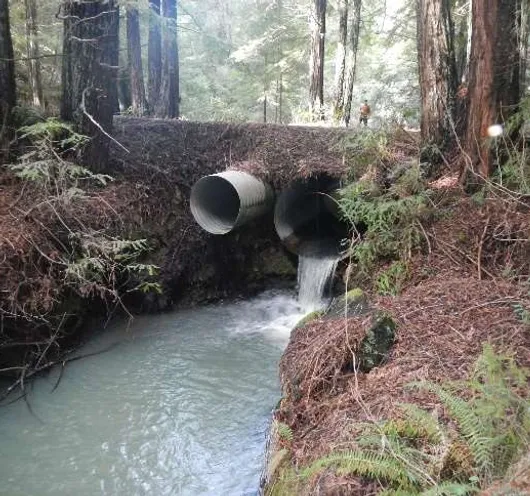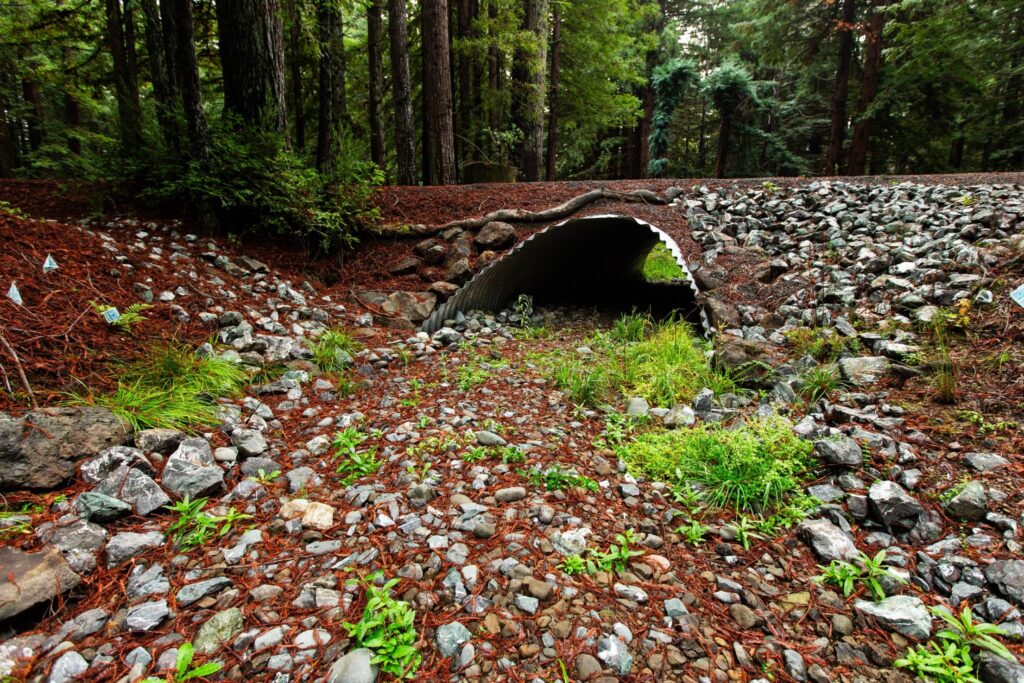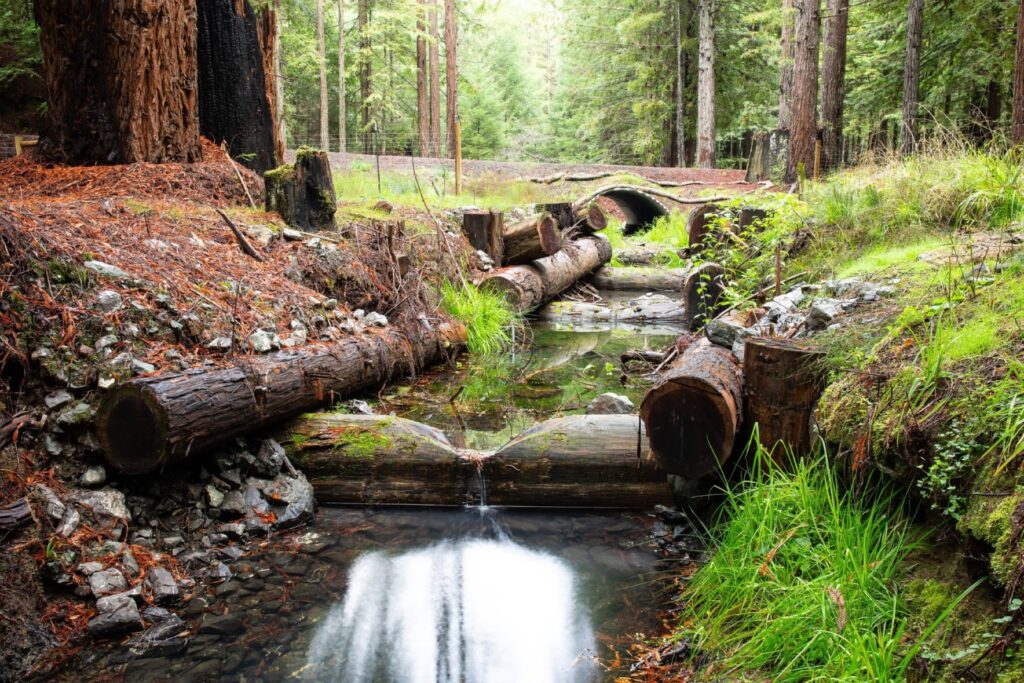
This project developed engineering plans for replacing a failing road crossing on Neefus Gulch — a tributary to the North Fork Navarro River in Mendocino County — with a stream simulation arch culvert, and for installing 14 large wood structures to arrest an active knickpoint in a severely incised 1,600-foot channel reach. The designs were part of a broader restoration effort that also removed an upstream earthen dam. Subsequent monitoring documented 10 coho salmon redds and two steelhead redds, including in reaches where salmon had not spawned for over 70 years.
Location: Neefus Gulch is a 1.4-square-mile tributary to the North Fork Navarro River, near the Rancho Navarro community in Mendocino County, CA. The project reach covers approximately 1,600 feet of channel between the Appian Way road crossing and the Masonite Industrial Road bridge. The North Fork Navarro River flows to the Navarro River, which enters the Pacific Ocean near the town of Navarro.
Historical Fish Presence: Neefus Gulch is a documented salmon-bearing stream within the Navarro River watershed, which historically supported Central California Coast (CCC) coho salmon (Oncorhynchus kisutch, federally endangered), steelhead (O. mykiss, federally threatened), and Chinook salmon. Fish had not been able to spawn in the upper portions of Neefus Gulch for more than 70 years prior to fish passage restoration on Neefus Gultch.
Project Lead: Trout Unlimited – North Coast Coho Project (Fort Bragg, CA)
Project Partners: Michael Love & Associates, Inc. (project engineer); Mendocino Redwood Company (landowner); California Department of Fish and Wildlife (CDFW); Pacific States Marine Fisheries Commission (grant administrator)
CFPF Funding: $39,513
Project Description: T This was a design-phase project addressing two connected problems on Neefus Gulch: an unstable road crossing at Appian Way and a severely incised channel reach downstream of it. Historical removal of old-growth wood, possible channel realignment, and reduced sediment supply from an upstream earthen dam had left a 1,600-foot reach with a prominent 3.5-foot knickpoint actively migrating toward the Appian Way crossing.
The project developed designs for both elements. For the Appian Way crossing, the replacement design called for a 56-foot-long, 12-foot 10-inch wide by 8-foot 4-inch high structural plate metal pipe arch culvert with a closed bottom, designed using CDFW’s stream simulation approach. A series of 10 engineered log steps was designed to establish a stable stream profile from the culvert outlet to the existing channel approximately 150 feet downstream. For the channel itself, the team performed a topographic survey, HEC-RAS hydraulic modeling, and geomorphic assessment, producing field-ready designs for 14 large wood structures to be placed between the knickpoint and Masonite Road. These structures were intended to trap sediment, raise the streambed, and arrest knickpoint migration — stabilizing the channel and protecting the new crossing from future incision. This work was one component of a larger effort that also included removal of an 18-foot earthen dam upstream, which was expected to restore sediment supply to the reach.
Expected Completion: Fall 2019
Project Effectiveness: The broader Neefus Gulch restoration program has since demonstrated strong results: Trout Unlimited fisheries biologists observed 10 coho salmon redds and two steelhead redds in Neefus Gulch, with eight in newly restored habitat above former barriers — areas where salmon had not spawned in over 70 years.