This project constructed five large wood and earthwork structures — including a Venturi jam, deflector jam, apex bar jam, inlet jam, and excavated alcove — on Lawrence Creek, a tributary to Yager Creek in the lower Van Duzen River watershed in Humboldt County, to restore hydrologic connectivity to off-channel habitats and increase low-velocity winter rearing refugia for ESA-listed coho salmon.
Location: Lawrence Creek, a tributary to Yager Creek in the lower Van Duzen River watershed, Humboldt County. The Van Duzen River drains into the Eel River approximately 13 miles upstream of its confluence with the Pacific Ocean. The project site is located approximately 7 miles north of Highway 36 east of Fortuna, on timberland managed by Humboldt Redwood Company.
Historical Fish Presence: Lawrence Creek and the Yager Creek watershed support ESA-listed coho salmon, for which the off-channel and side channel habitat targeted by this project provides critical low-velocity winter rearing refugia. The broader Van Duzen and Eel River system also supports steelhead trout. This project was the third phase of a multi-phase effort to improve off-channel and side channel habitat within the Lawrence Creek watershed.
Project Lead: Trout Unlimited – North Coast Coho Project
Project Partners: Pacific Watershed Associates (Engineering), VS Shinn (Construction), Humboldt Redwood Company/Humboldt Sawmill Company (Landowner, in-kind materials and fish relocation services), NOAA Restoration Center, North Coast Regional Water Quality Control Board (SEP award)
CFPF Funding: $48,029
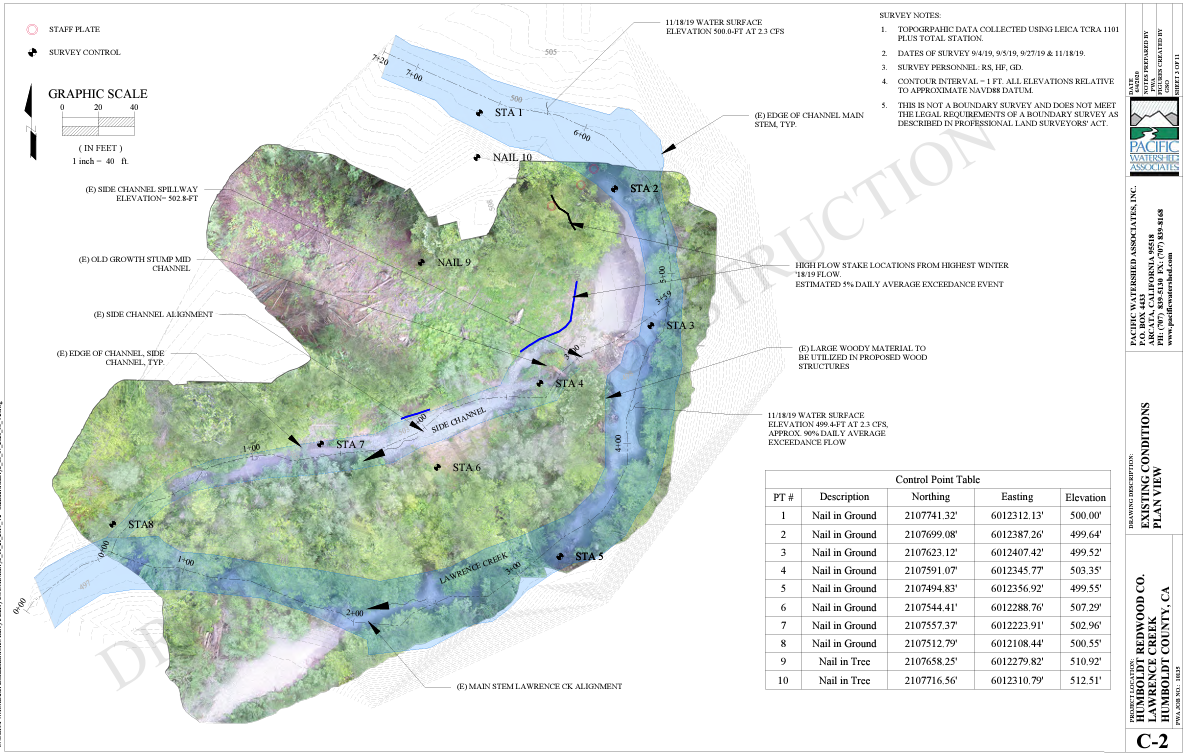
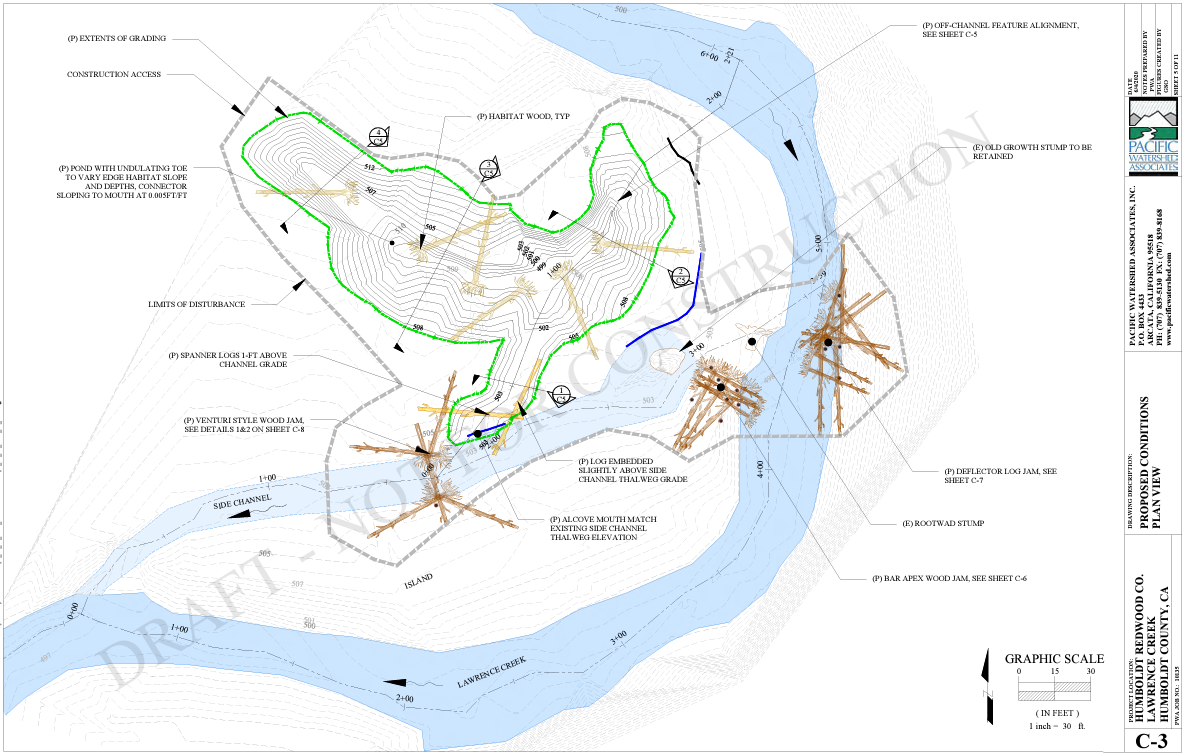
Project Description: This was Phase 3 (Lawrence 3.0) of a multi-phase off-channel habitat restoration effort on Lawrence Creek. The project restored hydrologic connectivity between Lawrence Creek and adjacent historic floodplain features by constructing five large wood structures and an excavated alcove. An apex bar jam and deflector jam placed in the mainstem raise water surface elevation under high flows, inducing flow into the side channel. A Venturi jam and inlet jam direct water into the newly constructed off-channel alcove, which was excavated and lined with large wood to create sheltered, low-velocity rearing habitat. The alcove is designed to be hydraulically connected during 15% exceedance flows and greater — approximately 55 days per year on average. Construction involved 29 large wood pieces with rootwads, 35 without, 22 medium wood pieces, approximately 2,100 cubic yards of earthwork, boulders, and rock.
Expected Completion: October 2022
Project Effectiveness: Construction was completed October 14, 2022, with photographic monitoring conducted before and after implementation. As-built drawings were completed and overlaid on design plans. The alcove was inundated and holding water at the time of final photo documentation on October 28, 2022, indicating the structures were functioning as designed. Formal monitoring of coho salmon use of the new habitat features was anticipated to continue through September 2023 under the primary NOAA funding award.